
English 


Views: 0 Author: Site Editor Publish Time: 2026-09-03 Origin: Site


Is your facility bleeding capital through high energy costs? E-commerce, pharmaceutical distribution, and online grocery delivery are expanding at breakneck speeds. Consequently, the industry faces an unprecedented demand for highly efficient cold chain logistics centers. Unfortunately, legacy insulation materials frequently fail under these heavy operational loads. When thermal envelopes degrade, the results are immediate: severe product spoilage, overworked compressors, and critical fire safety risks.
To combat these structural failures, engineering experts and facility managers are overhauling their approach to building envelopes. In this technical guide, we will break down why Polyisocyanurate (PIR) composite panels have become the baseline standard for constructing high-performance, structurally secure cold storage facilities.
Unmatched Thermal Efficiency: High-density cores (typically 40-42 kg/m³) drastically reduce base thermal loads, minimizing compressor runtime.
Active Fire Safety: Operating as a premium barrier, the material self-extinguishes and forms a carbon char layer to halt flame spread.
Cost-Effective TCO: Despite a marginally higher initial procurement cost than EPS, the long-term energy savings and 30-year lifecycle yield a superior Return on Investment.
Rapid Deployment: Precision tongue-and-groove joint systems eliminate thermal bridging while cutting on-site installation time by up to 40%.
Regulatory Compliance: Utilizing zero-ODP blowing agents, these panels align with strict 2026 ESG and green building standards.
Modern temperature-controlled hubs are no longer simple block-and-mortar warehouses. Today, they are highly complex, energy-intensive ecosystems requiring precise environmental engineering. As the volume of perishable goods moving through global supply chains scales up, the physical infrastructure supporting them must adapt to harsher operational demands.
Recent market analyses reveal two major shifts fundamentally changing cold room construction. First, the rapid adoption of Automated Storage and Retrieval Systems (AS/RS) means facilities are being built taller—often exceeding 30 meters. These high-bay warehouses demand cladding materials with exceptional structural rigidity and wind-load resistance. Second, stringent global carbon reduction mandates are forcing operators to target net-zero emissions. Upgrading HVAC systems is no longer enough. Engineers now recognize that passive energy saving—achieved through an optimized, airtight building envelope—is the most reliable method to slash Scope 2 emissions.
A single logistics hub frequently houses ambient sorting areas (15°C to 20°C), chilled processing zones (0°C to 10°C), and deep-freeze blast rooms (-40°C). Maintaining these distinct microclimates adjacent to one another requires a flawless thermal barrier.
The correct warehouse insulation panel acts as the primary defense against thermal bridging and interstitial condensation. When humid external air meets internal freezing temperatures, substandard insulation allows vapor to penetrate the wall cavity. This inevitably causes ice expansion within the panels, leading to structural degradation and catastrophic cold chain failure. Advanced composite paneling creates an absolute, moisture-proof seal.
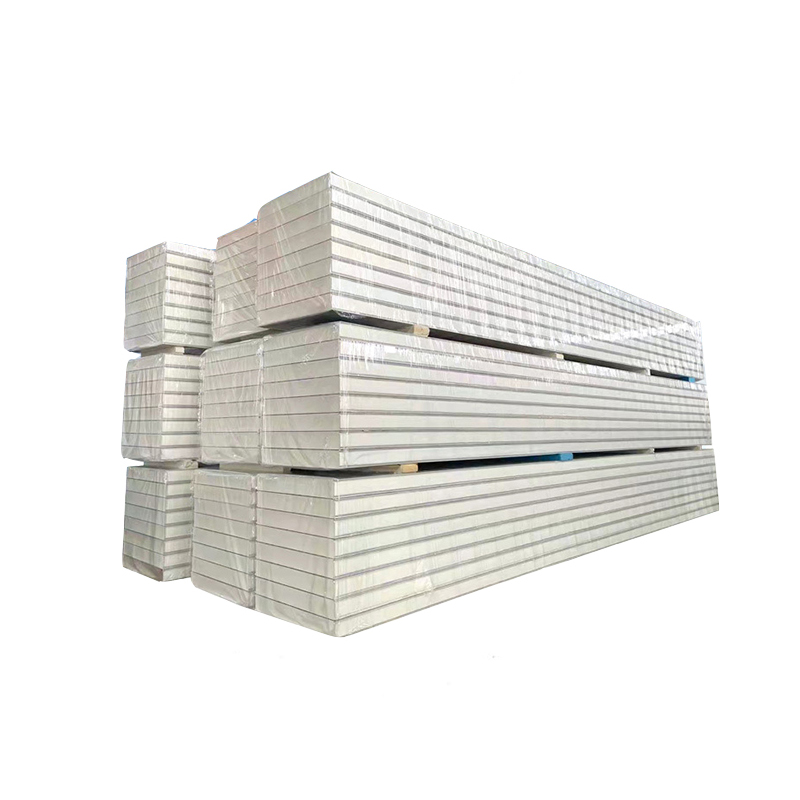
To make financially sound procurement decisions, project managers must understand the underlying material science of modern insulation.
A PIR composite panel is an engineered building material designed for extreme thermal stability. The core consists of Polyisocyanurate, a highly cross-linked, rigid thermosetting polymer foam. During manufacturing, this dense foam (usually injected at 40-42 kg/m³ density) is permanently bonded between two durable metal facings. The exterior steel—typically 0.4mm to 0.8mm thick—provides structural rigidity and impact resistance against forklift traffic, while the internal core delivers exceptional thermal resistance.
A frequent debate among contractors revolves around the technical differences between standard Polyurethane (PU) and Polyisocyanurate (PIR). While both are urethane-based, their chemical architectures dictate vastly different field performances.
Specifically, PIR is manufactured using a higher ratio of methylene diphenyl diisocyanate (MDI) to polyol, with the reaction occurring at elevated temperatures. This complex process creates robust isocyanurate ring structures within the foam matrix. These molecular rings are inherently stable. Consequently, PIR boasts superior dimensional strength at cryogenic temperatures and significantly higher fire resistance compared to legacy PU foam.
Selecting the correct cladding dictates the operational success of a cold room. Here are the objective engineering reasons why this material has become the industry benchmark.
Fire safety is paramount in warehousing, where combustible packaging is abundant. Standard foams often melt, drip, and accelerate flame spread. In stark contrast, PIR functions as a highly effective fire resistant panel due to its unique chemical charring mechanism.
When exposed to direct, intense heat, the surface of the core cross-links further to form a hardened carbonaceous char layer. This barrier insulates the deeper foam, prevents dripping, and starves the fire of oxygen. Because of this property, premium panels routinely achieve stringent B1 (flame retardant) fire ratings, satisfying the strict requirements of modern industrial insurance policies.
The defining metric for insulation is its thermal conductivity (lambda value, λ). PIR delivers one of the lowest thermal conductivities commercially available, typically testing between 0.020 and 0.022 W/m·K.
This allows structural engineers to achieve incredibly high R-values using thinner walls. For facility owners, this translates directly to maximized internal storage volume. Thinner walls yield more cubic meters of usable inventory space per square foot of real estate, directly boosting revenue capacity.
In sub-zero environments, moisture ingress is just as destructive as heat leakage. The core features a highly dense structure with over 90% closed cells. This microscopic architecture inherently rejects water absorption and blocks vapor transmission.
When integrated with impermeable metal facings and precision-sealed joints, the system eliminates interstitial condensation. This prevents internal mold growth and destructive ice expansion, ensuring the envelope remains structurally sound for decades.
To justify capital expenditures, decision-makers must rigorously evaluate advanced composites against legacy alternatives like EPS (Expanded Polystyrene) and standard PU.
Feature / Material | EPS (Expanded Polystyrene) | PU (Polyurethane) | PIR (Polyisocyanurate) |
|---|---|---|---|
Thermal Conductivity (λ) | ~0.038 W/m·K (Poor) | ~0.024 W/m·K (Good) | ≤0.022 W/m·K (Excellent) |
Fire Resistance | Highly Flammable (Melts) | Combustible (B2/B3) | Self-extinguishing (B1) |
Dimensional Stability | Prone to shrinkage | Can warp below -20°C | Stable at -40°C |
Procurement teams frequently note that PIR carries a 10% to 15% higher initial material cost compared to EPS. However, analyzing the Total Cost of Ownership reveals a completely different financial picture. The long-term ROI is driven by massive energy savings, extended compressor lifespans, and substantial insurance premium reductions. Furthermore, the warp-free nature of the material ensures 30+ years of service with virtually zero maintenance downtime.
Logistics architecture is highly segmented. The versatility of these panels allows them to be custom-manufactured for specific temperature zones across a single complex.
Maintaining extreme sub-zero temperatures is a monumental engineering challenge. Any thermal leakage forces refrigeration units to run continuously. For these harsh environments, heavy-duty panels (150mm to 200mm thickness) are mandatory. The extreme dimensional stability ensures the joints do not contract or crack under severe freezing conditions, protecting high-value frozen inventory.
Food and pharmaceutical processing zones require a delicate balance between temperature adherence and strict clinical hygiene. Medium-thickness panels (75mm to 100mm) are highly effective here. In these washdown areas, the standard steel facing is often upgraded to 304-grade stainless steel or coated with food-grade PVC to withstand aggressive daily chemical sanitization.
The loading dock is the most vulnerable thermal point in any industrial cold storage facility. Frequent door cycles expose the internal climate to ambient heat, creating massive thermal shock. Installing robust 50mm to 75mm panels in loading bays creates a stable thermal buffer zone. This actively prevents condensation on floors and safeguards inventory during delicate transit handoffs.
A one-size-fits-all approach is a guaranteed path to failure in industrial refrigeration. Selecting the appropriate specification requires precise calculations based on your operational data.
Panel thickness directly determines thermal resistance. Over-specifying wastes capital, while under-specifying guarantees chronic energy loss. As a baseline engineering standard:
Ambient / Sorting Rooms (10°C to 20°C): 50mm thickness.
Chillers / Processing (0°C to 10°C): 75mm – 100mm thickness.
Standard Freezers (-18°C to -25°C): 120mm – 150mm thickness.
Blast Freezers (Below -25°C): 200mm thickness.
The internal environment dictates the facing material. For standard dry storage, 0.4mm to 0.6mm Prepainted Galvanized Iron (PPGI) with a polyester coating is highly durable. However, if your facility processes corrosive materials, handles seafood, or requires high-pressure hot water cleaning, upgrading to 0.5mm - 0.8mm stainless steel is essential to prevent rust and maintain the structural integrity of the wall.
As the global push for sustainability accelerates, construction standards for logistics facilities are undergoing a massive transformation. Energy efficiency is transitioning from an operational choice to a strict legal mandate.
Global treaties, such as the Kigali Amendment, are forcing the refrigeration industry to dramatically reduce its carbon footprint. Facilities relying on substandard EPS envelopes are facing steep retrofitting costs to meet incoming 2026 carbon mandates. By aggressively reducing the thermal load on HVAC systems, high-performance cladding directly decreases greenhouse gas emissions.
Furthermore, utilizing top-tier energy saving building materials plays a vital role in earning prestigious green building certifications like LEED or BREEAM. Modern panel production utilizes eco-friendly blowing agents with zero Ozone Depletion Potential (ODP), instantly boosting a corporation's ESG profile for institutional investors.
To ensure long-term profitability, modern cold storage operators cannot afford to compromise on their building envelopes. From unparalleled thermal efficiency that aggressively slashes daily energy consumption, to active fire safety mechanisms that protect invaluable assets, PIR is the objective choice for high-performance construction.
By specifying the correct materials today, facility managers guarantee a secure, cost-effective, and future-proof logistics hub. Ready to optimize your facility's thermal performance? Evaluate your specific temperature requirements and explore professional structural solutions at Greenlvgreen to secure maximum energy savings, superior fire resistance, and decades of durability for your next industrial project.
Under normal operating conditions and with proper preventative maintenance, a high-quality installation will easily last 30 to 40 years. This longevity is primarily due to the closed-cell structure, which prevents moisture vapor transmission. Unlike fibrous insulation that sags and loses R-value when wet, PIR maintains its structural rigidity and thermal resistance decades after installation.
They carry a marginally higher initial capital cost—usually about 10% to 15% more than standard Polyurethane. However, the investment is rapidly recovered through lower daily energy consumption, reduced wear-and-tear on refrigeration compressors, and significantly lower property insurance premiums due to the B1 fire safety rating.
Absolutely. Modern continuous manufacturing lines produce panels tailored to highly specific architectural requirements. They can be cut to exact lengths, manufactured in various thicknesses (50mm up to 200mm), and utilizing different steel gauges. This customization minimizes on-site scrap waste and ensures a seamless, airtight fit.
It creates a continuous, highly efficient thermal envelope. With a thermal conductivity as low as 0.020 W/m·K, it severely restricts heat transfer from the warm exterior to the cold interior. This passive insulation strategy drastically reduces the continuous workload placed on HVAC machinery, slashing daily electrical power consumption.
During the high-temperature manufacturing process, a chemical cross-linking occurs forming highly stable isocyanurate rings. When exposed to an intense flame, these molecular rings cause the surface of the foam to char rather than melt. This carbon char layer acts as a protective barrier, insulating the deeper foam and cutting off the oxygen supply, allowing the material to self-extinguish.
PIR possesses exceptional dimensional stability, meaning it resists shrinking or warping even under extreme temperature fluctuations (Delta-T). In high-bay Automated Storage and Retrieval Systems where panels span significant heights, this stability prevents the metal facings from delaminating from the core, ensuring the structural integrity of tall cold room walls.
Industrial panels typically utilize a precision-milled tongue-and-groove joint system, often reinforced with integrated cam-locks for freezer applications. This interlocking mechanism pulls the panels tightly together, creating a seamless, airtight seal that completely eliminates thermal bridging and drastically speeds up the on-site construction timeline.


