



Views: 0 Author: Site Editor Publish Time: 2026-07-27 Origin: Site


Formwork failures are unforgiving on construction sites. Inadequate shoring leads to catastrophic structural collapses, severe safety hazards, and compounding project delays. You need equipment that matches load requirements and site conditions perfectly. Over-specification wastes budget unnecessarily, while under-specification breaches essential safety protocols. We provide a systematic, engineering-led framework for evaluating shoring equipment. You will move beyond basic comparisons to assess load capacities, material grades, and compliance standards. Choosing the right Steel Support requires precision and technical understanding. Engineers must evaluate static weights, dynamic forces, and environmental factors before procurement. This guide breaks down the critical dimensions of shoring selection. You will learn how to match equipment specifications directly to your site demands. Proper selection prevents accidents and keeps concrete pours on schedule.
Load Capacity Dictates Selection: The primary driver for choosing a steel support is the maximum operational load, factoring in both static concrete weight and dynamic construction loads.
Standardization Ensures Safety: Compliance with international standards (such as EN 1065) is non-negotiable for verifying the structural integrity of a formwork steel prop.
Surface Treatment Impacts ROI: The choice between hot-dip galvanized, electro-galvanized, and painted finishes directly determines the equipment's lifespan and total cost of ownership.
Site-Specific Variables Matter: Ground bearing pressure, bracing requirements, and slab heights must be integrated into the final procurement decision.
Calculate dead loads accurately before selecting any equipment. Wet concrete density sits around 24 kN/m³. You must add the mass of the formwork panels and primary beams. Reinforcement steel adds another layer of static weight. Live loads complicate the calculation further. Workers moving across the deck create dynamic forces. Concrete dumping from pump hoses generates significant impact loads. Heap loads occur when concrete accumulates unevenly before vibration. Dynamic equipment like power trowels adds stress to the supporting structure. Apply appropriate safety factors to account for these variables. Local engineering codes typically mandate margins between 1.5 and 2.0.
The load-carrying capacity of a Formwork Steel Prop dynamically decreases as you extend it. This buckling length behavior requires careful structural calculation. A unit rated for 30 kN at two meters might only support 15 kN at three meters. Engineers must consult specific load charts for every extension height. Here is a standard workflow for load assessment:
Determine the total volume and weight of the wet concrete per square meter.
Calculate the combined weight of the timber, plywood, and steel reinforcement.
Add the mandated live load allowance for workers and equipment.
Apply the regional safety factor multiplier to establish the ultimate design load.
Cross-reference this design load with the manufacturer's extension capacity charts.
Height adjustability matters on every construction site. Telescopic ranges allow micro-adjustments under heavy loads. You need precise leveling to ensure flat concrete slabs. Uneven terrain and sloped slabs complicate installations significantly. Standard flat base plates struggle on angled surfaces. Articulating base plates solve these alignment issues. They pivot to maintain full surface contact with the ground. Self-aligning drop heads accommodate sloped ceiling designs. Micro-adjustment threads let workers tweak heights after the primary formwork is laid. This adaptability prevents localized stress concentrations on the shoring system. Site conditions rarely match the perfect blueprints. Your equipment must bridge the gap between theory and reality.
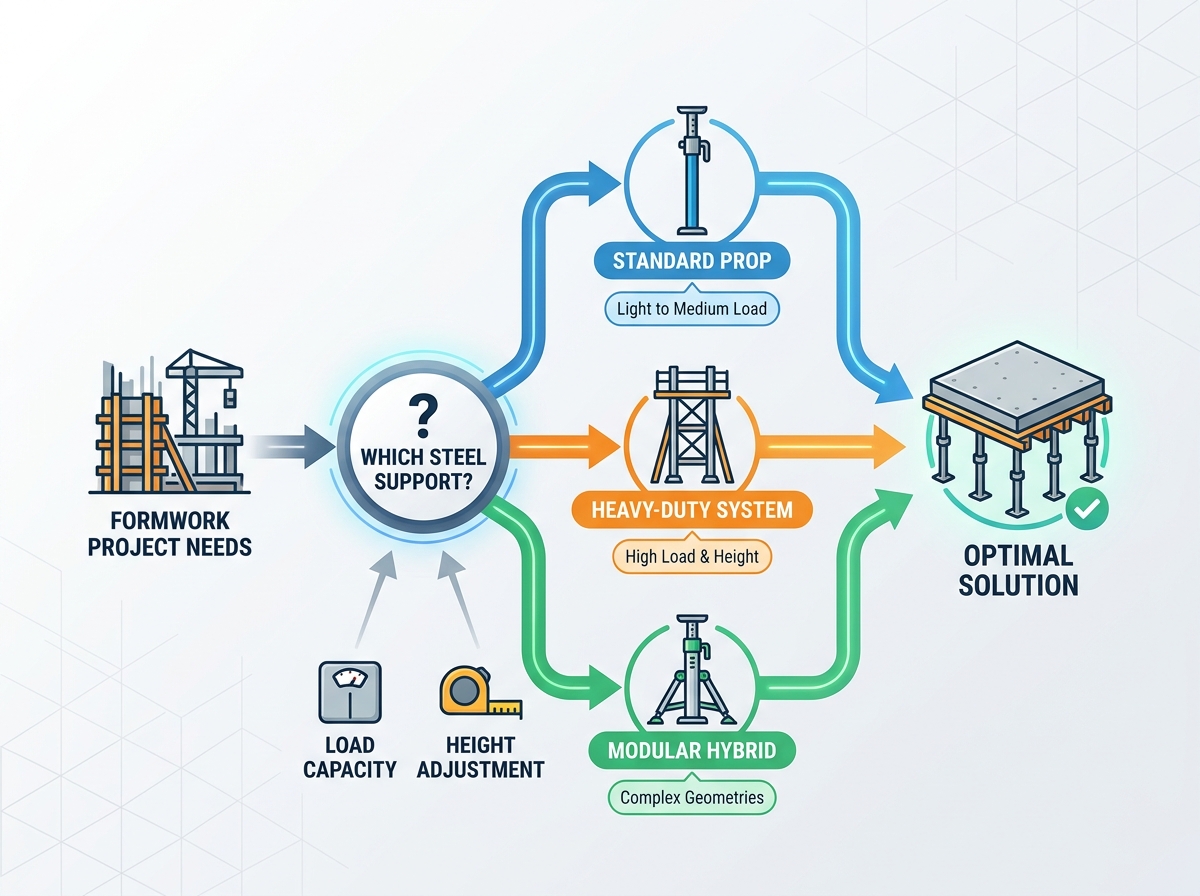
These units handle standard slab formwork efficiently. They fit residential and mid-rise commercial projects perfectly. Manufacturers classify them into light-duty, medium-duty, and heavy-duty categories. The EN 1065 Class system defines their nominal minimum capacity standards. Classes A, B, C, D, and E provide clear performance benchmarks. Class A props suit light residential pours. Class E props handle massive commercial slabs. You adjust them by extending the inner tube and securing the pin. The threaded collar provides the final height calibration. They are fast to install and easy to transport. Single props work best for heights under four meters. Beyond that, stability becomes a primary concern.
EN 1065 Class | Typical Application | Relative Load Capacity |
|---|---|---|
Class A | Light residential slabs | Low |
Class B & C | Standard commercial floors | Medium |
Class D & E | Heavy civil and industrial slabs | High |
High-clearance structures require robust shoring solutions. Heavy civil engineering projects and bridge decks rely on shoring towers. Modularity offers distinct advantages over single props. Vertical load-path alignment transfers weight directly to the ground. Superior load distribution prevents localized soil failure. Towers interlock with horizontal ledgers and diagonal braces. This creates a rigid, three-dimensional support matrix. They resist lateral forces from wind and concrete pumps effectively. Shoring towers accommodate massive concrete volumes safely. Assembly takes longer than single props, but the safety margins increase exponentially. You use them when ceiling heights exceed standard prop limits.
Aligning and plumbing wall formwork demands specific tools. Push-pull props support column and wall formwork efficiently. Their dual-action design resists tension from wind loads. They also handle compression from concrete pouring pressure simultaneously. Standard props only handle downward gravity loads. Push-pull units feature specialized articulating end plates. You anchor one end to the ground and the other to the wall panel. The threaded collar allows precise vertical alignment. Workers spin the collar to push or pull the formwork into plumb. This ensures perfectly straight concrete walls. They are essential for high-rise core wall construction.
Standard steel grades directly impact yield strength. Q235 and Q345 (or S235 and S355) offer different structural elasticity. Higher grades improve buckling resistance under heavy loads. Q345 steel provides superior tensile strength for high-rise applications. Inner and outer tube wall thickness ranges from 2.0mm to 4.0mm. Thicker walls correlate directly with higher maximum extension capacity. A 2.0mm wall suits light residential work. A 4.0mm wall handles heavy civil infrastructure. Thin tubes dent easily during site handling. Dents compromise the structural integrity and load capacity instantly. Always verify the steel grade and wall thickness before purchasing.
Open-thread and closed-thread designs perform differently on site. Open threads expose the adjustment mechanism entirely. They are self-cleaning but vulnerable to concrete splatter. Dried concrete jams open threads easily. Closed threads protect the mechanism with a steel sleeve. This prevents stripping but complicates internal cleaning. Cast iron adjustment nuts offer different durability than drop-forged steel. Drop-forged nuts withstand hammer blows during stripping better than cast iron. Self-cleaning thread configurations reduce operational downtime significantly. They push dirt out as you turn the collar. Smooth thread operation speeds up formwork leveling.
G-pins, line pins, and chained high-tensile pins provide varying shear strength. Chained pins prevent loss on busy construction sites. Lost pins lead to dangerous unauthorized substitutions. Standard base and head plate dimensions typically measure 150x150mm. Pre-drilled holes ensure secure fastening to timber bearers. Built-in safety mechanisms protect workers during assembly. Anti-dislodgement systems prevent the inner tube from sliding out accidentally. Hand-clearance safety margins leave a minimum 100mm space when fully collapsed. This prevents hand-pinching during rapid dismantling. Safety features reduce site injuries and liability.
Robotic welding ensures absolute consistency in joint penetration. Manual welding carries inherent human error risks. Consistent welds guarantee reliable load transfer between the base plate and tube. Welding quality certifications like ISO 3834 prove structural durability. Inspect the weld seams for porosity or undercutting. Poor welds fail catastrophically under concrete weight. The collar sleeve weld takes massive shear stress. It must be flawless. Quality control during manufacturing dictates site safety.
Painted finishes carry a lower initial procurement cost. They require high maintenance and scratch easily during transport. Use them for dry climates or short-term projects. Powder coating provides better durability than standard liquid paint. It resists chipping effectively under rough handling. Electro-galvanization leaves a smooth finish with moderate corrosion resistance. It suits light-to-medium rental cycles perfectly. Hot-dip galvanization (HDG) requires the highest initial investment. It delivers superior interior and exterior tube rust resistance. HDG is mandatory for marine environments and multi-decade asset retention.
Surface Treatment | Durability | Corrosion Resistance | Best Use Case |
|---|---|---|---|
Standard Paint | Low | Minimal | Short-term, dry climates |
Powder Coating | Medium | Moderate | Standard residential projects |
Electro-Galvanized | High | Good | Rental fleets, medium-term use |
Hot-Dip Galvanized | Very High | Excellent | Marine environments, long-term assets |
Calculate cost-per-use to understand true equipment value. Depreciation over time matters more than upfront purchase price. Robust manufacturing extends usable life significantly. Continuous friction welding and reinforced collar sleeves keep equipment functional longer. A cheap prop might survive three pours before bending. A high-quality prop lasts for hundreds of cycles. Track the replacement rate of your shoring fleet. High replacement rates indicate poor initial material selection. Invest in durability to lower long-term operational expenses.
Operational costs include cleaning and thread oiling. Concrete buildup ruins adjustment threads quickly. Straightness testing between pours prevents unexpected buckling failures. Storage footprint impacts your yard logistics. Stackability and palletization compatibility streamline transport to new sites. Specialized stillages keep props organized and prevent transit damage. Proper storage prevents water pooling inside the tubes. Regular maintenance schedules keep the fleet safe and ready for deployment.
Project duration dictates your procurement strategy. High utilization rate thresholds justify capital expenditure over rental agreements. If you pour concrete continuously, buying makes sense. Short, specialized projects favor rental fleets. Self-owned fleets require strict inventory management. Tracking logistics and utilization rates maximize asset efficiency. Lost or damaged props eat into project margins. Evaluate your storage capacity before purchasing large quantities.
Out-of-plumb installation creates severe structural dangers. Eccentricity compromises load capacity instantly. A prop leaning just two degrees loses significant strength. Unbraced horizontal lengths invite buckling under heavy pours. Mandatory cross-bracing maintains system equilibrium. Integrate horizontal lacing and tripods at maximum extensions. Tripods hold the prop perfectly vertical during installation. Lacing tubes connect multiple props together. This prevents a single failure from causing a domino effect. Always use a spirit level during setup.
EN 1065 dictates rigorous requirements for adjustable telescopic props. Equivalent regional codes like ANSI/SSFI and AS 3610 ensure safety. Never procure uncertified equipment for any project. Undocumented systems from unverified manufacturers introduce massive liability. Certified props undergo independent destruction testing. They verify pin shear strength and tube buckling limits. Request testing certificates before accepting deliveries. Site inspectors will halt pours if shoring lacks proper documentation.
Prop settlement destroys slab integrity immediately. Uncompacted soil and fresh concrete slabs pose severe risks. Distribute concentrated point loads safely. Use sole boards, timber sleepers, and mudsills to manage ground pressure. A 150x150mm base plate punches through soft ground easily. A timber sleeper spreads that load over a larger area. Verify soil compaction rates before erecting shoring. Ground failure causes the entire formwork system to drop. This ruins the concrete pour and endangers workers below.
Selecting the right equipment balances certified load capacity, environmental durability, and project-specific geometry. Use standard painted props for short-term, low-clearance projects. Invest in galvanized, heavy-duty units for long-term fleet assets. Utilize modular shoring towers for civil infrastructure and high-clearance pours. Proper selection ensures site safety and structural integrity.
Audit your upcoming project load calculations thoroughly before procurement.
Request technical data sheets and compliance certificates from all suppliers.
Consult a structural engineer for a tailored shoring layout and bracing plan.
Implement strict pre-pour inspection checklists for vertical alignment.
A: Capacity varies by class under EN 1065 standards. Classes A through E define specific performance metrics. A standard prop might hold 30 kN when fully collapsed. This capacity decreases to 10-15 kN as you extend it to its maximum height. Always consult manufacturer load charts.
A: Determine the total slab weight and area load first. Identify the single prop capacity at your targeted extension height. Apply the required safety factor. Map the prop layout based on the primary and secondary beam spacing capabilities of your formwork system.
A: Open threads expose the adjustment mechanism. They are self-cleaning but vulnerable to concrete splatter. Closed threads feature a protective sleeve. This sleeve prevents concrete buildup and physical damage but makes internal cleaning more difficult over time.
A: Standard props optimize for vertical gravity loads like concrete slabs. Push-pull props feature specialized end joints and dual-acting collars. These dual-action units align and support vertical formwork, such as walls and columns, resisting both tension and compression.
A: EN 1065 guarantees rigorous independent testing. It verifies minimum load-bearing capacities, pin shear strength, and anti-dislodgement safety. Certified equipment meets strict manufacturing quality benchmarks. This compliance significantly reduces project liability and ensures site safety.
A: Perform visual checks before every installation. Look for bends, weld cracks, and rust. Conduct post-pour deflection inspections to identify overstressed units. Complete annual structural audits to verify tube straightness, thread integrity, and pin shear strength across your fleet.
A: Eccentric loading, over-extension, mechanical wear, and lack of lateral bracing cause buckling. Prevent failures by using tripods and horizontal lacing. Enforce strict plumb checks with spirit levels during installation to ensure vertical alignment.


