




| Quantity: | |
|---|---|


Product Introduction
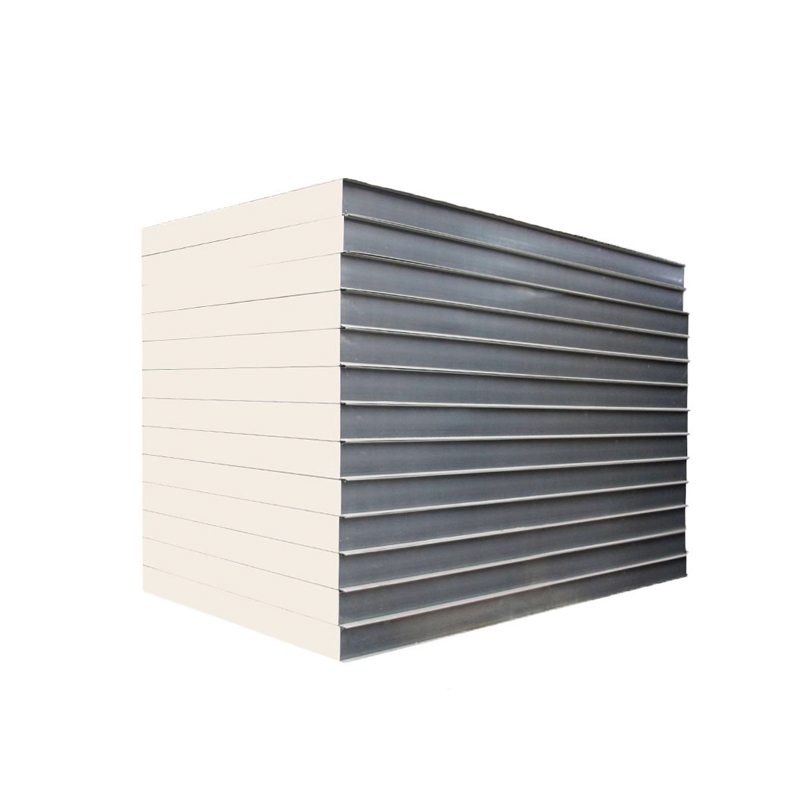
B1 Grade Flame-Retardant PIR Cold Storage Sandwich Panels are high-performance enclosure materials engineered for modern cold chain facilities. The panel adopts a solid sandwich structure, with polyisocyanurate (PIR) rigid foam as the core and high-strength color steel plates compounded on both sides. It integrates three core functions: excellent thermal insulation, top-tier fire safety, and reliable structural support, which can effectively block internal and external heat exchange and create a stable low-temperature environment. With a thermal conductivity as low as 0.024 W/(m·K) and compliance with B1 flame-retardant standard, this product is widely applied to walls and roofs of cold chain logistics centers, food processing workshops, and pharmaceutical cold storage. It serves as a key building material to ensure energy-saving, safe, and reliable operation of cold storage systems.
Product Advantage
The PIR core material has a decomposition temperature up to 260℃, much higher than the 220℃ of ordinary PUR materials. After special formula treatment, the panel has extremely low smoke density during combustion, exceeding the national B1 flame-retardant standard and providing higher safety for cold storage assets.
Advanced PIR foaming formula ensures the panel’s thermal conductivity remains stably ≤0.024 W/(m·K) for a long time. Thinner panels can achieve better insulation effects, reducing cold leakage and cutting long-term operating energy consumption by over 30%.
The core material density is ≥42kg/m³, with excellent compressive strength. Its bonding strength with high-quality metal panels is ≥0.12MPa, making it suitable for large-span and high-rise cold storage facilities without deformation or collapse risks.
The closed-cell rate of PIR core material is typically >95%, and water absorption rate is <2.5%. It hardly absorbs water in high-humidity cold storage environments, preventing insulation performance degradation and panel deformation (dimensional change rate <1.5%).
Produced with fluorine-free foaming agents like cyclopentane, the panels meet international environmental standards and have green building material certification. The 55% aluminum-zinc alloy coated steel surface ensures a service life of over 25 years.
Factory-prefabricated panels adopt precise full-mouth lock seam interlocking structure, combined with special low-temperature sealant for quick on-site splicing. This installation method eliminates cold bridges from the source and improves construction efficiency by up to 40%.
Technical Parameters
The product model is customized according to customer needs, with a fire rating reaching B1 grade to meet strict fire protection regulations. The panel specifications are fully customizable, adapting to different cold storage types such as low-temperature freezing and constant-temperature storage. It supports turn-key project services, ensuring one-stop solutions for customers. The product has obtained multiple authoritative certifications including CCC, ISO9001, and FM Approvals, which guarantees product quality and compliance with international standards. As a professional manufacturer with a 600,000-square-meter factory and 1,800 employees, the annual production capacity reaches 1,000 units, and the transport package can be customized to meet export and domestic transportation requirements.
Model NO. | PIR Panel |
Fire Rating | B1 |
Customized | Customized |
Service | Turn-Key Project |
Employees | 1800 |
Specification | Customized |
Origin | China |
Feature | Environmental, Fireproof, MetalPanel |
Certification | CCC, IS09001,FM Approvals |
Manufacturer | Yes |
Factory Area | 600000 Square Meters |
Transport Package | Customized |
Trademark | SQUARE |
Production Capacity | 1000units/Year |
FAQ
The core difference lies in molecular structure. PIR forms stable isocyanurate rings after modification, with a decomposition temperature of 260℃ (vs. 220℃ of PUR). It produces less smoke when burning and achieves more stable B1 flame-retardant effects.
No. The high closed-cell rate (>95%) ensures the thermal conductivity remains ≤0.024 W/(m·K) stably. The foam structure does not deform in ultra-low temperatures, maintaining reliable insulation performance.
It is reflected in three aspects: superior fire safety reduces insurance and risk costs; ultra-low thermal conductivity brings significant energy-saving benefits; high dimensional stability lowers maintenance frequency, leading to more advantageous life-cycle costs.
We adopt a dedicated eccentric hook lock or tongue-and-groove insertion system, combined with low-temperature elastic sealant. This design maintains tight interlock during temperature-induced shrinkage, achieving dual physical and chemical sealing and eliminating cold leakage effectively.


